I was reading an essay by C.S. Lewis whose title I've chosen for this note. He proposed a few experiments whereby one might test the efficasy of prayer. Things like praying for all the patients in one hospital and none in another hospital. Lewis dismissed these experiments. Lewis notes that prayer isn't magic. It's a request between persons. God is a person and he responds to our prayers in a personal way.
Science works in a mechanistic, impersonal fashion. F=ma always works the same way in an impersonal fashion. If God were the Force, there might be a way to do some religious rite, recite some prayer, and you'd get a predictable result. But God is personal. When you ask something from a person, the person may or may not comply.
The reliaility of the person, the character of the person, is revealed by how he keeps his promises. The business of salvation, forgiveness and redemption is applicable here. God has made promises on our behalf and we can count on him to keep them. How he keeps those promises is how he makes it personal.
Nevertheless, I am enough of a fan of science that I've thought about those experiments whereby one can measure the efficasy of prayer given the limitations described above.
I've observed two things that indicate the efficasy of prayer. First, my mother died back in the late '70s. I didn't notice it until much later, but I felt the loss of her prayers on my behalf. If Mom's in heaven, the's going to be too busy with heaven's busines to bother with me. I suppose if I were Catholic, I'd think that the saints in heaven pray for the living, but I'm Protestant and think they do not.
The second thing I noticed was years back when was first elected to serve as a deacon at my old baptist church. I felt some kind of uplift/support that I later realized was that someone in my church was praying for me. A few years later, I went into surgery for cancer. I asked for and got a lot of prayer from a broad spectrum of folks. It was an amazing sensation that I could feel.
Of course, citing anecdotes does not science make. Nevertheless, I think that one can directly and unscientifically gauge the efficasy of prayer when it goes away. And when it starts.
When you consider the nature of God, remember that God exists outside time. It seems hard to realize that all our prayers reach God simultaneously. This boggles the mind that God hears all of us talking all at once and all of our talk arrives at the same time. How shall God reply? And why would God reply?
First, God doesn't need anything from us. That's the nature of God. God is motivated to reply to our prayers to disclose something about himself. To do so he's got to be understood. This means God has to virtualize his responses to our prayers. God then shows his character through his answers.
In his essay Lewis notes that God seems less inclined to answer the prayers of those who know him best. He seems to withdraw. It's clear that God has nothing to prove to the faithful. They already know his character and have a relationship with them. Lewis seems to suggest that God's strong followers don't need coddling.
I think of those prayers that others have prayed for me. I know their prayers were answered. But they don't. And what of the prayers I pray for the stranger I see suffering or someone on the news or in another country? I'll never know how those prayers are answered.
That comes to the basic nature of prayer. It's relational. If I trust and love God, there's plenty of room to give him the benefit of the doubt. When there's things I know I'll never know, there's doubt. And love entails giving the benefit of the doubt. Thus considerations of the efficasy of prayer aren't necessary, if I trust and love God.
Sunday, October 02, 2005


Friday, September 30, 2005
Mark Twain's and Bill Bennet's Racism
Years back when I was a grad student at Michigan State, there was this huge liberal professor who wrote a column in the college paper. One time he wrote a sarcastic attack on racism. It was a clever use of irony and I recognized it immediately as such. However, a superficial reading of the column could give a stupid reader the impression that he was endorsing racism.
It was embarassing, because he got into big trouble when the Usual Suspects in the Racism Business jumped up and denounced him with anger and passion.
Maybe you've read that racist tract, Huck Finn, but Mark Twain. The author makes liberal use of the dreaded N-word as he describes the wise black slave Jim and the underclass Huck and their interactions with a menagerie of white fools.
Today, Mr. Bill Bennet is being condemned by the White House for making some kind of racist statement. I've heard the remarks in context. And I've heard others condemning stipulate that Mr. Bennet is not a racist.
In logic there is the notion of a reducio ad absurdum argument. A reducio argument follows this pattern: "If you believe 'a' then some absurd thing follows." For example, "If murdering Jews is a good then, then Hitler is a saint."
Perhaps the White House critics of Mr. Bennet will now accuse me of numbering that murderous tyrant among the saints.
It was embarassing, because he got into big trouble when the Usual Suspects in the Racism Business jumped up and denounced him with anger and passion.
Maybe you've read that racist tract, Huck Finn, but Mark Twain. The author makes liberal use of the dreaded N-word as he describes the wise black slave Jim and the underclass Huck and their interactions with a menagerie of white fools.
Today, Mr. Bill Bennet is being condemned by the White House for making some kind of racist statement. I've heard the remarks in context. And I've heard others condemning stipulate that Mr. Bennet is not a racist.
In logic there is the notion of a reducio ad absurdum argument. A reducio argument follows this pattern: "If you believe 'a' then some absurd thing follows." For example, "If murdering Jews is a good then, then Hitler is a saint."
Perhaps the White House critics of Mr. Bennet will now accuse me of numbering that murderous tyrant among the saints.
Saturday, September 24, 2005
Sabbath Keeping
I was with a group of friends and the topic of Sabbath keeping came up. Grand Rapids has a lot of Dutch Reformed folks and they treat Sunday like a Sabbath. You know, that commandment right after misusing the name of deity and honoring parents. But the Hollanders go hog wild and may make you wear a green "L" on your chest if they catch your mowing your LAWN on Sunday. (OK, they won't, but they are intense about such things. And the Scarlet Letter allusion is probably unclear, either. I should delete that last sentence.)
One friend complained that his father enforced rules about Sunday behaviour that seemed inconsistent. He could shoot hoops in his driveway, but he couldn't go down to his neighbor's and play a game. Other stories of Sunday rules were exchanged the general tenor of which was bemusement at the oddness of divergent standards of conduct.
This eventually reminded me of a story that my philosophy teacher, another preacher's kid, told about how HIS father kept the sabbath long ago: The family would sit quietly reading in the living room until Father would nod off, and then Mother would pull out her knitting and the kids could listen to the radio or otherwise occupy themselves while Father napped.
It sounds intolerably strict. But it WAS consistent. My friend's father and my philosophy teacher are roughly the same age and have both been Baptist pastors of note. So, I imagine some kind of generational process is going on. I think the previous generation rejected Strict Sabbath Keeping of the '40s and relaxed things a bit in the '70s. But that commandment is still around in the '00s. And WE'VE got to figure out what to tell OUR kids.
Loosening things up didn't evoke gratitude (because the kid never had to live under grampa's stricter standard), but it did evoke frustration at the inconsistency of the looser standard. The parent thinks his kid has it "a lot better" than what he had to put up with. But the kid doesn't appreciate it because the looser standard just moves the boundary, but it's still a boundary. And it's inconsistent, to boot!
I think the issue, the real issue, is in understanding God's Commandment. If you're the kind of guy who works 24x7 and never takes a break, you're not reflecting the Sabbath part of God's character. Something has to be different on Sabbath. But what is it?
My work calls upon me to sit in front of a keyboard (when I'm lucky on my deck) in a comfortable chair and write software. I love to write software and I think I'm good at it. Conversely, I got quite sweaty this afternoon digging a trench alongside my deck. That's not my day job and it was work, too. But I've done other things that make me sweaty that I thought were fun. They're not work. Can I do those non-trench-digging sweaty activities on Sunday? It's not simple. Jesus said that Sabbath was made for man, not vice-versa. Thus I think my relaxation and recreation is a legal Sabbath activity.
But I think that this line of thinking, "can I do this or not?" misses the point and falls into the Pharisee trap. You keep God's law not as a means to stay out of hell, but because of what kind of person lawkeeping makes you into. The ten commandments are a reflection of God's character. If you think someone who consistently acts like that is a fuddy-duddy, you really don't want to go to Heaven, because you'll find the place intolerable because the center of attention, God, is just like that. (And you don't want to be saved from your sins, just their penalty.)
My church meets on Sunday and it stresses is that the worship service is a particular time and space where the body's intention is to fellowship with God. Sabbath is an extension of that. The whole day should be lived mindful of God. Indeed this is like every other day, but this is a day to do so without the cares of work.
This results in an ethic that seems even more incoherent. The basketball game with the neighbor is legit provided it's a mindful-of-God game, but isn't if its not. I suppose that means you'll have to call your own fouls.
One friend complained that his father enforced rules about Sunday behaviour that seemed inconsistent. He could shoot hoops in his driveway, but he couldn't go down to his neighbor's and play a game. Other stories of Sunday rules were exchanged the general tenor of which was bemusement at the oddness of divergent standards of conduct.
This eventually reminded me of a story that my philosophy teacher, another preacher's kid, told about how HIS father kept the sabbath long ago: The family would sit quietly reading in the living room until Father would nod off, and then Mother would pull out her knitting and the kids could listen to the radio or otherwise occupy themselves while Father napped.
It sounds intolerably strict. But it WAS consistent. My friend's father and my philosophy teacher are roughly the same age and have both been Baptist pastors of note. So, I imagine some kind of generational process is going on. I think the previous generation rejected Strict Sabbath Keeping of the '40s and relaxed things a bit in the '70s. But that commandment is still around in the '00s. And WE'VE got to figure out what to tell OUR kids.
Loosening things up didn't evoke gratitude (because the kid never had to live under grampa's stricter standard), but it did evoke frustration at the inconsistency of the looser standard. The parent thinks his kid has it "a lot better" than what he had to put up with. But the kid doesn't appreciate it because the looser standard just moves the boundary, but it's still a boundary. And it's inconsistent, to boot!
I think the issue, the real issue, is in understanding God's Commandment. If you're the kind of guy who works 24x7 and never takes a break, you're not reflecting the Sabbath part of God's character. Something has to be different on Sabbath. But what is it?
My work calls upon me to sit in front of a keyboard (when I'm lucky on my deck) in a comfortable chair and write software. I love to write software and I think I'm good at it. Conversely, I got quite sweaty this afternoon digging a trench alongside my deck. That's not my day job and it was work, too. But I've done other things that make me sweaty that I thought were fun. They're not work. Can I do those non-trench-digging sweaty activities on Sunday? It's not simple. Jesus said that Sabbath was made for man, not vice-versa. Thus I think my relaxation and recreation is a legal Sabbath activity.
But I think that this line of thinking, "can I do this or not?" misses the point and falls into the Pharisee trap. You keep God's law not as a means to stay out of hell, but because of what kind of person lawkeeping makes you into. The ten commandments are a reflection of God's character. If you think someone who consistently acts like that is a fuddy-duddy, you really don't want to go to Heaven, because you'll find the place intolerable because the center of attention, God, is just like that. (And you don't want to be saved from your sins, just their penalty.)
My church meets on Sunday and it stresses is that the worship service is a particular time and space where the body's intention is to fellowship with God. Sabbath is an extension of that. The whole day should be lived mindful of God. Indeed this is like every other day, but this is a day to do so without the cares of work.
This results in an ethic that seems even more incoherent. The basketball game with the neighbor is legit provided it's a mindful-of-God game, but isn't if its not. I suppose that means you'll have to call your own fouls.
Wednesday, August 31, 2005
Theodicy
When I was a child I hated gravity. It made high places unsafe. Falling hurt, climbing hills on my bike was hard. Why couldn't we just not have gravity and we'd be able to fly by just flapping our arms. Of course you know that was wrong. If God turned off gravity right now, all the air would go spinning off the earth and we'd all be launched into space because the Earth is spinning and without gravity, we'd fly off like water droplets on a spinning bike-tire.
I changed my mind so completely, I advise new parents to be as consistent as gravity when raising kids.
A long time ago, I came to see a unity between Law of the moral 10 Commandments sort and of the natural F=ma sort. The ancient Greeks called this organizing unity behind phenomena Logos. In the beginning was the Word. This led me to see Christ in this Logos either as its archetype, or something deeper. God is immutable and his essential laws won't change. Some laws directly reflect the moral character of God, whereas God told Moses things that had only a ceremonial basis back then. Maybe God will repeal the law of gravity, but he doesn't change laws capriciously.
Some weeks ago there was a tsunami and people questioned the goodness of God. But water and techtonic plates were merely obeying he laws of physics. These same laws of physics allow us to live. If nature behaves in a consistent, predictable fashion then there will be times when nature's forces can crush us.
That's the rub. We now understand the consistent, predictable behaviour of nature. We can detect tsunami's and issue warnings. We can track hurricanes by satellites. We can build levees to hold back water. We can evacuate threatened areas. God has given us sufficient gray matter to see these things coming and get ot of the way.
Then there's the matter of preparation. Nobody planned on building New Orleans below sea level. Last year another hurricane missed New Orleans. The word then was that levees couldn't handle a direct hit and after the city was flooded, it would be difficult to pump it dry again. I don't think signing the Kyoto protocol would have evaporated hurricane Katrina. But I do think that after last year's near miss, some serious attention should have been given to the problem of flooding.
That discloses the role of government in natural disasters. Shoddy governments can skate by for a long time. Something like a natural disaster discloses its failures. Ferinstance, inspectors are bribed and then buildings collapse. Emergency management roles may go to political cronies who prove unable to cope. It's up to the electorate to insist upon integrity in government.
So, does something like a natural disaster indicate that God is malign? What would God do differently? Repeal the law of gravity? But there's that spinning off into space business.
In addition to law there is mercy.
Two objects can't coexist in the same place at the same time. If you and I drive through the same intersection at the same time, our cars will go bonk. That's why we have traffic lights. I sat at a traffic light a couple saturdays ago. Distracted, I saw it a flash of green and I started off into the empty intersection. The blast of a car horn roused me and I saw that the green was the LEFT TURN ARROW. The light in my lane was red. Mortified, I realized that I should have had a car crash, but it was only mercy that spared me.
Mercy tells me that God is good. I see mercy as those remarkable times when circumstances should crush us, but they work out much better than anyone deserves. Why is mercy remarkable instead of customary? If it is customary, it's law and law is not mercy.
Theodicy is always the lame attempt to defend God or vindicate his reputation. I think that's a bad idea. God can defend himself much more ably than I could. I hope nobody thought this was what I was trying to do just now.
I changed my mind so completely, I advise new parents to be as consistent as gravity when raising kids.
A long time ago, I came to see a unity between Law of the moral 10 Commandments sort and of the natural F=ma sort. The ancient Greeks called this organizing unity behind phenomena Logos. In the beginning was the Word. This led me to see Christ in this Logos either as its archetype, or something deeper. God is immutable and his essential laws won't change. Some laws directly reflect the moral character of God, whereas God told Moses things that had only a ceremonial basis back then. Maybe God will repeal the law of gravity, but he doesn't change laws capriciously.
Some weeks ago there was a tsunami and people questioned the goodness of God. But water and techtonic plates were merely obeying he laws of physics. These same laws of physics allow us to live. If nature behaves in a consistent, predictable fashion then there will be times when nature's forces can crush us.
That's the rub. We now understand the consistent, predictable behaviour of nature. We can detect tsunami's and issue warnings. We can track hurricanes by satellites. We can build levees to hold back water. We can evacuate threatened areas. God has given us sufficient gray matter to see these things coming and get ot of the way.
Then there's the matter of preparation. Nobody planned on building New Orleans below sea level. Last year another hurricane missed New Orleans. The word then was that levees couldn't handle a direct hit and after the city was flooded, it would be difficult to pump it dry again. I don't think signing the Kyoto protocol would have evaporated hurricane Katrina. But I do think that after last year's near miss, some serious attention should have been given to the problem of flooding.
That discloses the role of government in natural disasters. Shoddy governments can skate by for a long time. Something like a natural disaster discloses its failures. Ferinstance, inspectors are bribed and then buildings collapse. Emergency management roles may go to political cronies who prove unable to cope. It's up to the electorate to insist upon integrity in government.
So, does something like a natural disaster indicate that God is malign? What would God do differently? Repeal the law of gravity? But there's that spinning off into space business.
In addition to law there is mercy.
Two objects can't coexist in the same place at the same time. If you and I drive through the same intersection at the same time, our cars will go bonk. That's why we have traffic lights. I sat at a traffic light a couple saturdays ago. Distracted, I saw it a flash of green and I started off into the empty intersection. The blast of a car horn roused me and I saw that the green was the LEFT TURN ARROW. The light in my lane was red. Mortified, I realized that I should have had a car crash, but it was only mercy that spared me.
Mercy tells me that God is good. I see mercy as those remarkable times when circumstances should crush us, but they work out much better than anyone deserves. Why is mercy remarkable instead of customary? If it is customary, it's law and law is not mercy.
Theodicy is always the lame attempt to defend God or vindicate his reputation. I think that's a bad idea. God can defend himself much more ably than I could. I hope nobody thought this was what I was trying to do just now.
Saturday, August 20, 2005
CVS Camera Cable
I have been repurposing a CVS one-time use camcorder into a general purpose camcorder. I've written about this before. But I thought I'd say a little more about building the cable.
To repurpose the CVS camcorder you need a custom cable. You can do this by soldering the end-connector from a Palm Pilot synch cable to USB cable. USB connectors have 4 conductors: +5v, ground, +data, -data. The USB cable's wires are nominally colored black, white, green and red.
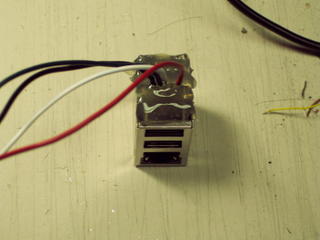 When you build a cable, you need to test it. Ohming out a cable entails attaching a multimeter to both ends of the cable. This can be a 3 or 4-handed job. To make this easier, I built a test jig as pictured here.
Someone gave me a dead motherboard with USB ports on it. I desoldered the USB sockets (with ethernet connector) pictured at the left. Then I soldered four clip leads to the USB signals coming out of the gizmo. Those four wires sticking out the top end in alligator clips. On the front of the block you'll see two USB sockets and an ethernet socket. The leads are connected to the top USB socket.
To ohm out your cable, plug the USB end in the socket and orient yourself with the Palm side of the cable. Orient the Palm connector with conductors facing upward, and the edge facing right. You'll see a row of 10 conductors. The first is on the left and the 10th is on the right.
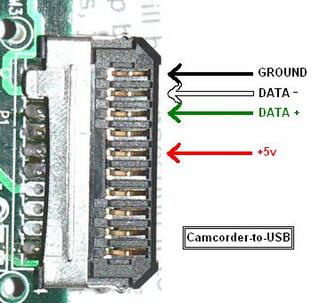 Clip the black lead to your multimeter. Touch the other side of your multimeter to the 10th pin on the Palm connector. It should be connected. Move on to the white lead. Attach it to the multimeter and check the 9th pin on the Palm connector. The green lead should match the 8th pin. Skip the 7th pin and check that the red lead matches the 6th pin on the Palm connector.
If all these signals work, you should be good to go. BUT first check to make sure no adjacent lines are shorted together. There should be no connection between pin 10 and 9, 9 and 8, 8 and 7, or 7 and 6. A bit of solder bridged pins 6 and 7 and that prevented the cable from working (despite ohming out correctly). Use a bright light and a magnifying glass to inspect your solder connections.
Further reading:
http://www.rkawakami.net/dakota/index2.html
http://www.mrbill.net/cvscam/cvscamera-cable-howto.pdf
http://www.maushammer.com/systems/dakotadigital/usb-cable.html
http://www.camerahacking.com/
Acknowledgement: I lifted the second image from "Maxwell Smart" on the camerahacking disussion forum. I definately recommend lurking there.
To repurpose the CVS camcorder you need a custom cable. You can do this by soldering the end-connector from a Palm Pilot synch cable to USB cable. USB connectors have 4 conductors: +5v, ground, +data, -data. The USB cable's wires are nominally colored black, white, green and red.
 When you build a cable, you need to test it. Ohming out a cable entails attaching a multimeter to both ends of the cable. This can be a 3 or 4-handed job. To make this easier, I built a test jig as pictured here.
Someone gave me a dead motherboard with USB ports on it. I desoldered the USB sockets (with ethernet connector) pictured at the left. Then I soldered four clip leads to the USB signals coming out of the gizmo. Those four wires sticking out the top end in alligator clips. On the front of the block you'll see two USB sockets and an ethernet socket. The leads are connected to the top USB socket.
To ohm out your cable, plug the USB end in the socket and orient yourself with the Palm side of the cable. Orient the Palm connector with conductors facing upward, and the edge facing right. You'll see a row of 10 conductors. The first is on the left and the 10th is on the right.
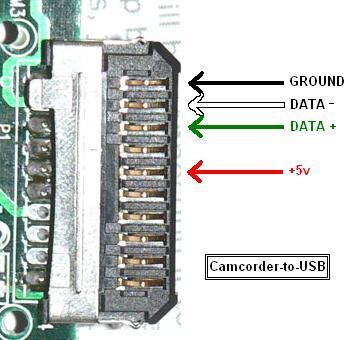 Clip the black lead to your multimeter. Touch the other side of your multimeter to the 10th pin on the Palm connector. It should be connected. Move on to the white lead. Attach it to the multimeter and check the 9th pin on the Palm connector. The green lead should match the 8th pin. Skip the 7th pin and check that the red lead matches the 6th pin on the Palm connector.
If all these signals work, you should be good to go. BUT first check to make sure no adjacent lines are shorted together. There should be no connection between pin 10 and 9, 9 and 8, 8 and 7, or 7 and 6. A bit of solder bridged pins 6 and 7 and that prevented the cable from working (despite ohming out correctly). Use a bright light and a magnifying glass to inspect your solder connections.
Further reading:
http://www.rkawakami.net/dakota/index2.html
http://www.mrbill.net/cvscam/cvscamera-cable-howto.pdf
http://www.maushammer.com/systems/dakotadigital/usb-cable.html
http://www.camerahacking.com/
Acknowledgement: I lifted the second image from "Maxwell Smart" on the camerahacking disussion forum. I definately recommend lurking there.
Serious Fun
Scott opens the throttle all the way. Then he calls out numbers. Fifty. Sixty. Seventy. Eighty. Then I feel a bump and I know the wheels are up. He pulls up in a steep climb--as steep a climb as a Cessna 172 does. And I think, “This is fun.” But then I realize how little holds us in the air. A bit of aluminum, an engine that had sputtered to life after a few balky tries. I remember how diligently Scott had performed the pre-flight ritual. Yeah, this is riskier than sitting in front of the TV. And I think, “Serious fun.”
The flight is smooth as polished metal. On the ground, temperatures are just below freezing. The air is dense and quiet. I presume it’s dry enough that icing is no problem. We take off at sunset and fly toLansing Riverview Airport
Things look different from the air. You see lines and wonder, “Is that 28th street?” It is. And you see long rows of headlights tracing a serpentine path across town and know it’s a freeway. After dark, you see mercury vapor and sodium floodlights. The bigger and brighter clusters must be shopping malls and the like.
When Scott gets in the air, he starts talking toGrand Rapids
PastGrand Rapids Lansing Lansing
At the halfway point, Scott tweaks the heading indicator. He mutters something about precession. I remember forgotten gyroscope lore. Precession, nutation. Cool stuff. Scott mentions that the compass is fairly accurate and mentions the dipping angle--more forgotten lore recollected. I smile at the three-dimensionality of lines of magnetic force. Scott utters pilot jargon and I know the science it touches. Knowing obscure things puffs one up. Scott will do an instrument landing atLansing
I start to grok the radio traffic: thinking like Scott is thinking and howLansing
Lansing
LansingLansing Lansing
A guy comes out and chocks our wheels. We get out and he asks if we need gasoline. We don’t. We go inside and ask the girl where we can get the $100 hamburger that was the whole point of this trip. She directs us to the Airport Tavern. I wasn’t listening to directions, assuming Scott was. He assumed I was listening. No problem. The FBO lends us a nice car and we take a bunch of right turns and we’re on the main drag in front of the airport. I recognize the road. The last time I drove this road I was in grad school running some errand that took me to the north end ofLansing
We pull into the Airport Tavern. It looks seedy as does the clientele. Not a problem. I briefly contemplate ordering a hamburger, but the special is Porterhouse steak. There’s no need to be too literal about his hundred-dollar-hamburger business. The steak is wonderful, cooked to perfection and tender and juicy. We eat steak and talk about airplanes and flying. It isn’t affected at all, it’s the most natural thing in the world. We finish and chat with the waitress. Nice lady, nice place. Well have to come back someday.
Back at the FBO we return the car and Scott’s return pre-flight is hurried and cursory. We’ve only been on the ground for an hour and the airplane is just wearing a skin of frost from sitting outside. Scott remembers to pull the chocks. It’s cold and we pile into the cockpit. The heater doesn’t work until we get in the air.Lansing
TheHobbs Hobbs
We’re back in the air and the flight home is as much fun as the flight out. There’s a deck of clouds at 3500 feet overGrand Rapids Lansing
We detour to the north and fly over my house. Scott circles while I call home on the cell phone. I can’t hear whether they pick up or not. I yell into the phone that we are circling overhead. Mary and the kids blink the yard lights for us. The rest of the flight goes over downtown and it is easy to pick out the landmarks.
We land at Riverview and Scott nails the centerline. The stall alarm squawks at the very moment the wheels touch down. It is perfect. It is serious fun.
The flight is smooth as polished metal. On the ground, temperatures are just below freezing. The air is dense and quiet. I presume it’s dry enough that icing is no problem. We take off at sunset and fly to
Things look different from the air. You see lines and wonder, “Is that 28th street?” It is. And you see long rows of headlights tracing a serpentine path across town and know it’s a freeway. After dark, you see mercury vapor and sodium floodlights. The bigger and brighter clusters must be shopping malls and the like.
When Scott gets in the air, he starts talking to
Past
At the halfway point, Scott tweaks the heading indicator. He mutters something about precession. I remember forgotten gyroscope lore. Precession, nutation. Cool stuff. Scott mentions that the compass is fairly accurate and mentions the dipping angle--more forgotten lore recollected. I smile at the three-dimensionality of lines of magnetic force. Scott utters pilot jargon and I know the science it touches. Knowing obscure things puffs one up. Scott will do an instrument landing at
I start to grok the radio traffic: thinking like Scott is thinking and how
Lansing
Lansing
A guy comes out and chocks our wheels. We get out and he asks if we need gasoline. We don’t. We go inside and ask the girl where we can get the $100 hamburger that was the whole point of this trip. She directs us to the Airport Tavern. I wasn’t listening to directions, assuming Scott was. He assumed I was listening. No problem. The FBO lends us a nice car and we take a bunch of right turns and we’re on the main drag in front of the airport. I recognize the road. The last time I drove this road I was in grad school running some errand that took me to the north end of
We pull into the Airport Tavern. It looks seedy as does the clientele. Not a problem. I briefly contemplate ordering a hamburger, but the special is Porterhouse steak. There’s no need to be too literal about his hundred-dollar-hamburger business. The steak is wonderful, cooked to perfection and tender and juicy. We eat steak and talk about airplanes and flying. It isn’t affected at all, it’s the most natural thing in the world. We finish and chat with the waitress. Nice lady, nice place. Well have to come back someday.
Back at the FBO we return the car and Scott’s return pre-flight is hurried and cursory. We’ve only been on the ground for an hour and the airplane is just wearing a skin of frost from sitting outside. Scott remembers to pull the chocks. It’s cold and we pile into the cockpit. The heater doesn’t work until we get in the air.
The
We’re back in the air and the flight home is as much fun as the flight out. There’s a deck of clouds at 3500 feet over
We detour to the north and fly over my house. Scott circles while I call home on the cell phone. I can’t hear whether they pick up or not. I yell into the phone that we are circling overhead. Mary and the kids blink the yard lights for us. The rest of the flight goes over downtown and it is easy to pick out the landmarks.
We land at Riverview and Scott nails the centerline. The stall alarm squawks at the very moment the wheels touch down. It is perfect. It is serious fun.
Sunday, August 14, 2005
Beyond Roe versus Wade
In 1973, Roe versus Wade legalized abortion in the the US, bypassing the politics courtesy of an appointed for life elite of jurists. Others have opined at length about the appropriateness of this legislation from the bench.
At the time Paul Ehrlich had written The Population Bomb and Malthusian scenarios were all the rage. Thomas Malthus and his followers has a long history of scary predictions that haven't panned out. According to these people, we should have all died sometime in the second term of the Reagan administration.
There was a real fear that overpopulation would be a real problem our society would have to solve. Abortion on demand seemed a reasonable component in solving the overpopulation problem. The fact that it dovetailed with what was then called "women's lib" contributed to its appeal. Today equal rights based on one's sex is acknowledged by all.
And today we're seeing some interesting demographics. In each country of the developed world, birth rates are flat and population growth has stopped. In the near future, nations will have to deal with the problem of population decline.
How can a society encourage population growth? One way is to pay women to have babies. That notion won't see much support in the next century when a large portion of the budget is going to Social Security recipients. It's cheaper to simply to pass laws against contraception.
That's an intrusive measure, but since the geezers of 2020 won't be much affected by laws against contraception, it's sure to get as many votes as those which increase Social Security benefits.
This looks like a bad thing and I think it is. I also think that once this thinking takes hold outside the ranks of the pro-life movement, the first change will be Roe versus Wade.
People want Roe versus Wade because they don't want babies. There are times when a child is a harmful disruption. The mother may not be prepared emotionally, financially, and otherwise for the demands of motherhood. There may be no support system (e.g. family) in place for nurturing the child. Moreover, it takes a lot of money to raise and educate a child. A lot of folks can't afford a large family.
Adoption has always existed because there are folks who want children, but cannot. The fact that these people are willing to do almost anything for a child has created a market that governments and lawyers have stepped into. There are legitimate concerns about adoptions and things must be done orderly and carefully. This has put pressure on the system to increase the price of adoption.
It seems that those who have an interest in the demographics of a stable population should put pressure on the system to reduce the price of adoption. Moreover, crisis pregnancy centers successfully discourage abortions. However, they often come with a heavy-handed religious message that some may not like. Perhaps non-church groups could establish homes for wayward mothers (a victorian term) where they'd be encouraged to give up unwanted children for adoption and supported in that choice.
Think of the hordes of unborn Democrat voters who'd be saved.
At the time Paul Ehrlich had written The Population Bomb and Malthusian scenarios were all the rage. Thomas Malthus and his followers has a long history of scary predictions that haven't panned out. According to these people, we should have all died sometime in the second term of the Reagan administration.
There was a real fear that overpopulation would be a real problem our society would have to solve. Abortion on demand seemed a reasonable component in solving the overpopulation problem. The fact that it dovetailed with what was then called "women's lib" contributed to its appeal. Today equal rights based on one's sex is acknowledged by all.
And today we're seeing some interesting demographics. In each country of the developed world, birth rates are flat and population growth has stopped. In the near future, nations will have to deal with the problem of population decline.
How can a society encourage population growth? One way is to pay women to have babies. That notion won't see much support in the next century when a large portion of the budget is going to Social Security recipients. It's cheaper to simply to pass laws against contraception.
That's an intrusive measure, but since the geezers of 2020 won't be much affected by laws against contraception, it's sure to get as many votes as those which increase Social Security benefits.
This looks like a bad thing and I think it is. I also think that once this thinking takes hold outside the ranks of the pro-life movement, the first change will be Roe versus Wade.
People want Roe versus Wade because they don't want babies. There are times when a child is a harmful disruption. The mother may not be prepared emotionally, financially, and otherwise for the demands of motherhood. There may be no support system (e.g. family) in place for nurturing the child. Moreover, it takes a lot of money to raise and educate a child. A lot of folks can't afford a large family.
Adoption has always existed because there are folks who want children, but cannot. The fact that these people are willing to do almost anything for a child has created a market that governments and lawyers have stepped into. There are legitimate concerns about adoptions and things must be done orderly and carefully. This has put pressure on the system to increase the price of adoption.
It seems that those who have an interest in the demographics of a stable population should put pressure on the system to reduce the price of adoption. Moreover, crisis pregnancy centers successfully discourage abortions. However, they often come with a heavy-handed religious message that some may not like. Perhaps non-church groups could establish homes for wayward mothers (a victorian term) where they'd be encouraged to give up unwanted children for adoption and supported in that choice.
Think of the hordes of unborn Democrat voters who'd be saved.
Tuesday, August 09, 2005
CVS Disposable Camcorder Project
I saw a hacking project on Make: Blog to repurpose a CVS Disposable Camcorder and this note describes what I did.
Saturday after breakfast I dropped into CVS and paid $30 for a disposable camera. This camera is supposed to be used once and then returned to CVS for video extraction for an additional fee whereupon they will give you a DVD of your video and they'll recycle the camera.
I had read about various efforts to repurpose this camera by buying it, fabricating a cable for it, and then installing software to unlock and then extract the video onto my computer.
The project had hack value, so I bought the camera and started researching the project. Happily, others have done all the hard work, so I was able to glom onto a couple HOWTOs and download all the software.
The project seems to be well within the grasp of a technically oriented teenager. It doesn't entail anything more dangerous than cutting wires and soldering them. I should put my son to work building another interface cable and installing the drivers on my other laptop.
The first thing I did was to study the camcorder I'd just purchased. It had 3 buttons on the back and by pressing them all simultaneously while powering up the device, I was able to ascertain its firmware id. At the top of the camcorder is a sticker. Beneath it is a slot wherein you can see the edge of a circuit board and ten contacts.
Those contacts match the docking port of a Palm Pilot. Happily, I have several and I also had some surplus Handspring Prism docking stations. I decided to sacrifice one of these. That was a mistake. After I dremelled free the connector from my Prism docking station, I noticed its pins were spaced 8-wide instead of 10-wide. Ooops, discard that.
Second try I sacrificed a Palm Pilot M100 docking station. It had the right number of pins at the right spacing. I disassembled, and then desoldered it to get a little circuit board with nice plated-through holes. Sweet. I got the circuit board nice and clean and then picked around to find a USB cable to plug into it.
This is how you tell if a cable is wrong: you hook up the camcorder on one side and the computer on the other side, and nobody does anything. If the cable is good, you'll hear Windows make a bloop-beep sound of something being plugged into the USB port, and you'll hear the camera light up, beep and power on. (You don't need to install any software to get this much response.) But my cable was bad and I got nada.
Remember that Handspring Prism USB docking port? I tried that. Advice: DON'T. It has a nonstandard USB connector that doesn't pass through the red signal. More Advice: Ohm out (test continuity) all the wires of any cable you try to fabricate.
I went sorting through junk boxes and a friend gave me a USB cable for my second attempt.
The Palm docking cradle's circuit board didn't clean up as nicely the second time I desoldered all its wires. I didn't have any solder wick, and discovered that air-in-a-can works wonder on hot solder. It removed the excess and got the board relatively clean without more than a few pinprick burns. (I became a Mathematician instead of an Electrical Engineer, because when I was in High School I couldn't solder. Go figure.)
After you have a working cable, you can connect the camcorder to your Windows XP box and it'll tell you that new hardware has been detected and ask, "Do you want to install drivers for it?"
DON'T tell it you do unless the following drivers have been installed. And do tell it you want it to ask again the next time it sees this unknown device. (There's a checkbox you want to keep clear.)
Drivers are fairly straightforward, but there's not much handholding. You need two programs: one low-level usb library thang and one higher-level talk to the camcorder thang.
The low-level thang is LibUsb-Win32 on Source Forge you'll need to decide which version you like and then download, not one, but two files. I downloaded these:
Once you've got this installed on your machine, you're ready to plug in the camcorder again. Still don't setup the device driver, but DO run inf-wizard. It'll look at the USB and ask you some questions you can click through, and it'll create an INF file. Pay attention to that and where you put it.
Then go back to Windoze and tell it you do want to install the device driver, and you do want to specify where it goes to pick up the device driver and you will tell it get the device driver out of that INF file.
Windows should then be satisfied and you should be ready to talk to the camcorder.
At this point, there are two perfectly suitable programs: Ops and SaturnDownload. They probably share a lot of code. Ops is a clicky windows MFC program and SaturnDownload is a command-line program. It's simpler and I think I prefer it because it leaves no room for mistakes. Just run it and it'll download your videos.
To recap, this is what you'll have to do:
Acknowledgements: I didn't do NOTHING except scope out what everybody else had posted and follow the instructions they left for me. This missive exists to point out the parts where I had to scratch my head and figure out what I was doing wrong.
UPDATE: some have complained of being unable to see the video despite hearing the audio. Problem is lack of the xvid codec. I found the following files in my c:\windows\system32 directory. I presume they are vital to getting the codec to work. (You probably need to google for someone who knows what he's doing.)
Saturday after breakfast I dropped into CVS and paid $30 for a disposable camera. This camera is supposed to be used once and then returned to CVS for video extraction for an additional fee whereupon they will give you a DVD of your video and they'll recycle the camera.
I had read about various efforts to repurpose this camera by buying it, fabricating a cable for it, and then installing software to unlock and then extract the video onto my computer.
The project had hack value, so I bought the camera and started researching the project. Happily, others have done all the hard work, so I was able to glom onto a couple HOWTOs and download all the software.
The project seems to be well within the grasp of a technically oriented teenager. It doesn't entail anything more dangerous than cutting wires and soldering them. I should put my son to work building another interface cable and installing the drivers on my other laptop.
The first thing I did was to study the camcorder I'd just purchased. It had 3 buttons on the back and by pressing them all simultaneously while powering up the device, I was able to ascertain its firmware id. At the top of the camcorder is a sticker. Beneath it is a slot wherein you can see the edge of a circuit board and ten contacts.
Those contacts match the docking port of a Palm Pilot. Happily, I have several and I also had some surplus Handspring Prism docking stations. I decided to sacrifice one of these. That was a mistake. After I dremelled free the connector from my Prism docking station, I noticed its pins were spaced 8-wide instead of 10-wide. Ooops, discard that.
Second try I sacrificed a Palm Pilot M100 docking station. It had the right number of pins at the right spacing. I disassembled, and then desoldered it to get a little circuit board with nice plated-through holes. Sweet. I got the circuit board nice and clean and then picked around to find a USB cable to plug into it.
This is how you tell if a cable is wrong: you hook up the camcorder on one side and the computer on the other side, and nobody does anything. If the cable is good, you'll hear Windows make a bloop-beep sound of something being plugged into the USB port, and you'll hear the camera light up, beep and power on. (You don't need to install any software to get this much response.) But my cable was bad and I got nada.
Remember that Handspring Prism USB docking port? I tried that. Advice: DON'T. It has a nonstandard USB connector that doesn't pass through the red signal. More Advice: Ohm out (test continuity) all the wires of any cable you try to fabricate.
I went sorting through junk boxes and a friend gave me a USB cable for my second attempt.
The Palm docking cradle's circuit board didn't clean up as nicely the second time I desoldered all its wires. I didn't have any solder wick, and discovered that air-in-a-can works wonder on hot solder. It removed the excess and got the board relatively clean without more than a few pinprick burns. (I became a Mathematician instead of an Electrical Engineer, because when I was in High School I couldn't solder. Go figure.)
After you have a working cable, you can connect the camcorder to your Windows XP box and it'll tell you that new hardware has been detected and ask, "Do you want to install drivers for it?"
DON'T tell it you do unless the following drivers have been installed. And do tell it you want it to ask again the next time it sees this unknown device. (There's a checkbox you want to keep clear.)
Drivers are fairly straightforward, but there's not much handholding. You need two programs: one low-level usb library thang and one higher-level talk to the camcorder thang.
The low-level thang is LibUsb-Win32 on Source Forge you'll need to decide which version you like and then download, not one, but two files. I downloaded these:
- libusb-win32-device-bin-0.1.10.1.tar.gz
- libusb-win32-filter-bin-0.1.10.1.exe
Once you've got this installed on your machine, you're ready to plug in the camcorder again. Still don't setup the device driver, but DO run inf-wizard. It'll look at the USB and ask you some questions you can click through, and it'll create an INF file. Pay attention to that and where you put it.
Then go back to Windoze and tell it you do want to install the device driver, and you do want to specify where it goes to pick up the device driver and you will tell it get the device driver out of that INF file.
Windows should then be satisfied and you should be ready to talk to the camcorder.
At this point, there are two perfectly suitable programs: Ops and SaturnDownload. They probably share a lot of code. Ops is a clicky windows MFC program and SaturnDownload is a command-line program. It's simpler and I think I prefer it because it leaves no room for mistakes. Just run it and it'll download your videos.
To recap, this is what you'll have to do:
- scrape up $30 from a paper route or something for the CVS camera
- scrounge parts for a cable from an old Palm synch cable and a USB cable. Learn to solder them together. If you're a True Hack, you could install a USB socket in the camcorder case. That idea has some appeal. Assemble the cable.
- install libusb-win32, create an INF, give it to Windows, install SaturnDownload
- take a lot of videos and gloat about how much cheaper this is than theKodak EasyShare that I paid 10x more for six months ago.
- http://www.maushammer.com/systems/cvscamcorder/
- http://www.makezine.com/blog/archive/2005/08/how_to_cvs_vide_1.html
- http://camerahacks.10.forumer.com/viewtopic.php?t=621
- http://www.i-hacked.com/content/view/182/94/
- http://www.suburbanninja.com/
Acknowledgements: I didn't do NOTHING except scope out what everybody else had posted and follow the instructions they left for me. This missive exists to point out the parts where I had to scratch my head and figure out what I was doing wrong.
UPDATE: some have complained of being unable to see the video despite hearing the audio. Problem is lack of the xvid codec. I found the following files in my c:\windows\system32 directory. I presume they are vital to getting the codec to work. (You probably need to google for someone who knows what he's doing.)
- 09/06/2004 05:06 PM 53,248 xvid.ax
- 07/03/2004 09:59 PM 524,288 xvidcore.dll
- 07/03/2004 10:08 PM 139,264 xvidvfw.dll
Thursday, July 21, 2005
The Candidate
Some weeks back there was a knock at the door. I answered and a pleasant volunteer stood there exhorting me to vote for someone. When asked why she affirmed that the person she represented would help:
Her response was a bit of deer-in-the-headlights quickly followed by, "let me get the candidate." It wasn't necessary and I thanked the volunteer nonetheless. My neighbor dropped in a bit later and we were chatting when the candidate showed up a minute after that.
The Candidate was an altogether pleasant person and I could tell that if elected, she'd do everything she could to accomplish those admirable goals she enumerated. But she was a bit vague on how she'd accomplish them. I figured that it would be rude to press her at this point and changed the subject.
Our cul-de-sac is evenly split into two factions as fierce as the slave-state vs free-state conflict of years bygone. You can characterize our conflict in our cul-de-sac as the Forces of Light versus the Forces of Darkness. I explained to her that in the last year or so the business of putting up street lights has come before the city commission and I asked how she'd vote. (I think the lights we have now work fine without the city dunning us a few thousand bucks to put them in.)
Her answer showed her skill as a politician, because she said what I wanted to hear, but didn't actually commit herself to either Light or Darkness.
At this point, I wanted to know who's team this rising star was playing on. I had a suspicion, but I wanted it confirmed. The race is a non-partisan one so one has to ask sneaky questions to ascertain Republican versus Democrat. What's her resume look like? She's worked in child-protection stuff. I said, "Oh, that's how Hillary Clinton got her start." I figured that if she flashed on the name, she'd out herself as flaming lib or raging clinton-hater. She said nothing. Very astute.
She left me with her campaign literature and my neighbor went home too. Scanning the literature I went through the names of endorsers. Ah, the usual suspects appeared, all of whom are more-or-less identified with one party. OK, good to know which team she's on.
I figure she has a bright future in politics. At least she's following to the template of her party. It becomes clear when you look deeper and compare/contrast with the other candidates that this party has put up in the last few election cycles.
In 1980, Ronald Reagan won a landslide election over a fellow who complained of malaise as he blamed the American people for his failings. Listening to NPR at the time, the complaint was that Reagan's politics were vague and sugarcoated and they obscured hard things that must be done. The response was a fellow from Minnesota who promised to raise taxes and another landslide followed. After another Massachusetts liberal lost another election, Mr. Clinton reversed this losing streak by promising middle-class tax cuts and complaining the worst economy in 50 years was caused by 12 years of greed.
I believe Mr. Clinton's party didn't understand why Mr. Reagan won. They thought his success was pure charm & platitudes. And Mr. Clinton's success seemed to vindicate this opinion. Since then I've seen a pattern repeated in campaigns from folks on that side of the aisle.
There are a lot of yard signs for the candiddate. She dispatched another volunteer who handed out her retooled literature today. No policy details, but lots of endorsements. I am grateful for her brother's service to our country in Iraq. Her opponent has caught up somewhat in the lawn sign department.
To be fair, the candidate hasn't made a secret of what she wants to do. If you goto her website, she provides a vision of getting every penny of tax money due our community and funding safety programs (such as more street lighting!) and stricter regulation to protect our children. In fact, we'll create jobs while restoring the environment. I wonder why her volunteer didn't say this at the beginning?
The election is August 2nd. It should be interesting to see how the candidate does.
- strengthen families
- strengthen the city
- create jobs and improve the environment
Her response was a bit of deer-in-the-headlights quickly followed by, "let me get the candidate." It wasn't necessary and I thanked the volunteer nonetheless. My neighbor dropped in a bit later and we were chatting when the candidate showed up a minute after that.
The Candidate was an altogether pleasant person and I could tell that if elected, she'd do everything she could to accomplish those admirable goals she enumerated. But she was a bit vague on how she'd accomplish them. I figured that it would be rude to press her at this point and changed the subject.
Our cul-de-sac is evenly split into two factions as fierce as the slave-state vs free-state conflict of years bygone. You can characterize our conflict in our cul-de-sac as the Forces of Light versus the Forces of Darkness. I explained to her that in the last year or so the business of putting up street lights has come before the city commission and I asked how she'd vote. (I think the lights we have now work fine without the city dunning us a few thousand bucks to put them in.)
Her answer showed her skill as a politician, because she said what I wanted to hear, but didn't actually commit herself to either Light or Darkness.
At this point, I wanted to know who's team this rising star was playing on. I had a suspicion, but I wanted it confirmed. The race is a non-partisan one so one has to ask sneaky questions to ascertain Republican versus Democrat. What's her resume look like? She's worked in child-protection stuff. I said, "Oh, that's how Hillary Clinton got her start." I figured that if she flashed on the name, she'd out herself as flaming lib or raging clinton-hater. She said nothing. Very astute.
She left me with her campaign literature and my neighbor went home too. Scanning the literature I went through the names of endorsers. Ah, the usual suspects appeared, all of whom are more-or-less identified with one party. OK, good to know which team she's on.
I figure she has a bright future in politics. At least she's following to the template of her party. It becomes clear when you look deeper and compare/contrast with the other candidates that this party has put up in the last few election cycles.
In 1980, Ronald Reagan won a landslide election over a fellow who complained of malaise as he blamed the American people for his failings. Listening to NPR at the time, the complaint was that Reagan's politics were vague and sugarcoated and they obscured hard things that must be done. The response was a fellow from Minnesota who promised to raise taxes and another landslide followed. After another Massachusetts liberal lost another election, Mr. Clinton reversed this losing streak by promising middle-class tax cuts and complaining the worst economy in 50 years was caused by 12 years of greed.
I believe Mr. Clinton's party didn't understand why Mr. Reagan won. They thought his success was pure charm & platitudes. And Mr. Clinton's success seemed to vindicate this opinion. Since then I've seen a pattern repeated in campaigns from folks on that side of the aisle.
There are a lot of yard signs for the candiddate. She dispatched another volunteer who handed out her retooled literature today. No policy details, but lots of endorsements. I am grateful for her brother's service to our country in Iraq. Her opponent has caught up somewhat in the lawn sign department.
To be fair, the candidate hasn't made a secret of what she wants to do. If you goto her website, she provides a vision of getting every penny of tax money due our community and funding safety programs (such as more street lighting!) and stricter regulation to protect our children. In fact, we'll create jobs while restoring the environment. I wonder why her volunteer didn't say this at the beginning?
The election is August 2nd. It should be interesting to see how the candidate does.
Monday, July 18, 2005
What's Wrong With The Dutch
I live in Grand Rapids, Michigan, where a large number of Hollanders settled upon leaving their imperfect homeland for a better land. They've enriched the west side of Michigan by their presence. (And I'm not being sarcastic.) But I have a problem with the Dutch.
Same problem with Dr. Laura. I think a lot of Grand Rapids Dutch people like Dr. Laura. I quit listening to Dr. Laura when a woman called who was distraught, consumed with guilt after having broken one of the Ten Commandments. (About which Dr. Laura wrote a very good book I used in my Baptist Sunday School class several years back.) What made me turn off Dr. Laura was her reply to the guilt-consumed woman: You did it. Suffer. (She probably said something kinder, but that's what I heard.)
Dr. Laura is right to condemn Christians for being too quick to forgive or expect forgiveness. Catholics with their crucifixen helpfully remind us that though grace is free, its price is infinite.
But humans are only human and certain reasonable accommodations are in order when you live in this fallen world. Human nature is flawed and humans make mistakes. Sometimes humans choose an expedient over the right thing.
Obviously, one can lose weight by eating less and exercizing more. The mere application of the will and self-control suffices to make one lean and strong. I have a friend of Dutch descent who accurately put forth this opinion when I went on an Atkins kick. And he's right. Ask Ten Dutchmen and you will hear the right answer. I like being around folks of Dutch descent because they keep me sharp and keep me trying 100% to stay on top of things. My complaint here is that being right isn't enough.
At my writers' group I was chatting with a friend of Dutch descent and the topic of children in public came up. Ah yes. I recall how it was when my kids were very young and what it was like taking them out in public. A harrowing affair. My attitude toward parents with misbehaving children changed when I saw how difficult it was to keep rein on my own tykes. No, my kids were all very well behaved, but the peril that they might not struck fear into my heart. Mindful of this, I'm more inclined to shrug when kids slip the leash of their parents' iron discipline.
It's said that Germans make no small mistakes. Since everyone makes mistakes, that should hint at the kind of mistakes that Germans make. And I think Dutch and the Germans are a lot alike. (Being of both Dutch and German ancestry, there's a lot of that in me.)
Having described the behaviours of the Dutch that trouble me, I'll try to explain what I think the problem is. Let me explain.
A decade back I bought a book entitled "Design Patterns." I gave it a quick skim and put it on my bookshelf. I noted the chapter headings and a few buzzwords. Design Patterns are cool and I'd feel a bit of a poseur if the topic came up. I knew of patterns better than I knew patterns. I never had a need to use patterns and if I did, I'd learn then. It wasn't that the book wasn't interesting. It's just that the book was a little bit like a dictionary or an encyclopedia. Something you read when you're in high school on a lazy summer day and you're bored. Thus the book's excellent contents never made it from the bookshelf into my brain.
My boss went on a trip and he read another book on the plane. "Head First Design Patterns" He came back and bought a copy for everyone in his department. My first reaction was an eye-roll. "This stuff is fluff," I thought. But the publisher was O'Reilly. I read the first chapter and it consisted of an apology for the fluffy appearance of pictures and cartoons, etc. Ferinstance, it told me to drink lots of water so my brain would work better. And it got across the point that if the info in the book didn't make it into my brain, the book failed in its purpose.
That's what I think is wrong with the Dutch. They (we) fail to take imperfect human nature into account. Like Dr. Laura they throw up their hands in the face of human failings. Seeing this response to failure motivates those around them. If you haven't failed this time around, you'll be terrified into making sure you don't fail next time around. Or maybe you just shut down in response.
My whole point is effectiveness. People are motivated by high standards. The Dutch set high standards. When standards are too high, standards demotivate and discourage. What's wrong with the Dutch is they can forget to take imperfect human nature into account and act accordingly. The Heads First book lowers its sights to accommodate the shortened attention spans of harried software professionals. Thus it accomplishes something The Gang Of Four didn't.
For further reading:
Same problem with Dr. Laura. I think a lot of Grand Rapids Dutch people like Dr. Laura. I quit listening to Dr. Laura when a woman called who was distraught, consumed with guilt after having broken one of the Ten Commandments. (About which Dr. Laura wrote a very good book I used in my Baptist Sunday School class several years back.) What made me turn off Dr. Laura was her reply to the guilt-consumed woman: You did it. Suffer. (She probably said something kinder, but that's what I heard.)
Dr. Laura is right to condemn Christians for being too quick to forgive or expect forgiveness. Catholics with their crucifixen helpfully remind us that though grace is free, its price is infinite.
But humans are only human and certain reasonable accommodations are in order when you live in this fallen world. Human nature is flawed and humans make mistakes. Sometimes humans choose an expedient over the right thing.
Obviously, one can lose weight by eating less and exercizing more. The mere application of the will and self-control suffices to make one lean and strong. I have a friend of Dutch descent who accurately put forth this opinion when I went on an Atkins kick. And he's right. Ask Ten Dutchmen and you will hear the right answer. I like being around folks of Dutch descent because they keep me sharp and keep me trying 100% to stay on top of things. My complaint here is that being right isn't enough.
At my writers' group I was chatting with a friend of Dutch descent and the topic of children in public came up. Ah yes. I recall how it was when my kids were very young and what it was like taking them out in public. A harrowing affair. My attitude toward parents with misbehaving children changed when I saw how difficult it was to keep rein on my own tykes. No, my kids were all very well behaved, but the peril that they might not struck fear into my heart. Mindful of this, I'm more inclined to shrug when kids slip the leash of their parents' iron discipline.
It's said that Germans make no small mistakes. Since everyone makes mistakes, that should hint at the kind of mistakes that Germans make. And I think Dutch and the Germans are a lot alike. (Being of both Dutch and German ancestry, there's a lot of that in me.)
Having described the behaviours of the Dutch that trouble me, I'll try to explain what I think the problem is. Let me explain.
A decade back I bought a book entitled "Design Patterns." I gave it a quick skim and put it on my bookshelf. I noted the chapter headings and a few buzzwords. Design Patterns are cool and I'd feel a bit of a poseur if the topic came up. I knew of patterns better than I knew patterns. I never had a need to use patterns and if I did, I'd learn then. It wasn't that the book wasn't interesting. It's just that the book was a little bit like a dictionary or an encyclopedia. Something you read when you're in high school on a lazy summer day and you're bored. Thus the book's excellent contents never made it from the bookshelf into my brain.
My boss went on a trip and he read another book on the plane. "Head First Design Patterns" He came back and bought a copy for everyone in his department. My first reaction was an eye-roll. "This stuff is fluff," I thought. But the publisher was O'Reilly. I read the first chapter and it consisted of an apology for the fluffy appearance of pictures and cartoons, etc. Ferinstance, it told me to drink lots of water so my brain would work better. And it got across the point that if the info in the book didn't make it into my brain, the book failed in its purpose.
That's what I think is wrong with the Dutch. They (we) fail to take imperfect human nature into account. Like Dr. Laura they throw up their hands in the face of human failings. Seeing this response to failure motivates those around them. If you haven't failed this time around, you'll be terrified into making sure you don't fail next time around. Or maybe you just shut down in response.
My whole point is effectiveness. People are motivated by high standards. The Dutch set high standards. When standards are too high, standards demotivate and discourage. What's wrong with the Dutch is they can forget to take imperfect human nature into account and act accordingly. The Heads First book lowers its sights to accommodate the shortened attention spans of harried software professionals. Thus it accomplishes something The Gang Of Four didn't.
For further reading:
- Design Patterns (aka Gang Of Four)
Saturday, July 16, 2005
Harry Potter And The Half-Wit Fundamentalist
No, I'm not going to bash fundies. Well, maybe a little. There's times when I cringe, because I identify myself as a fundamentalist Christian. Or maybe an Evangelical. What makes me cringe the most is when a preacher starts talking about science. Since science guys have tended to bash bible thumpers, thumper preachers like to bash back. And when you're a science guy and a bible thumper... that's another story.
This essay is about Harry Potter. But before I go there, I'll recommend you go here to take this quiz. http://www.tk421.net/character/ I took the quiz and my score most closely matched Harry Potter!
Well, if i'm Harry Potter, I'd better explain how one does magic. I figure there's two approaches you can take to do magic:
1) bargain with some powerful being who performs some magic task for you. Ferinstance, the Devil and Daniel Webster. This kind of magic is a very personal thing. You have to establish some relationship with some being with whom you become codependent. Sorry, Alladin. The Witch of Endor (not Endora, that was on TV) summoned the prophet Samuel and that was personal, too. The Bible is pretty clear that this is a Bad Thing and Not Approved. Though, I suppose you could count Moses and the Prophets in this category as they did miracles thru their personal relationship with God. And that explains why this sort of magic is disapproved. The First Commandment says to have no other gods before God.
2) the second way to do magic is impersonal. pretty much anybody who says the incantation and does the gestures right unlocks some magic-power that does something. Larry Niven's Magic Goes Away stories. And Wiz Zumwalt. And of course, Harry Potter.
Ok, i've been playing fast and loose with fact and fiction to this point. But think of what it must have been like to be Isaac Newton. You've just invented calculus and you've stuck knitting needles in your eyes to figure out optics. You're messing with maths and formulae. And the some guy on the other side of campus is trying to turn lead into gold and figuring out physical chemistry in the process.
Newton didn't have these neat categories we have today of science and magic and alchemy. They were all smashed together in his head. I imagine he could have looked at the alchemists and their dark arts and foul smells and felt a twinge of guilt that he was doing something Not Right. Indeed, Newton managed to make a muddle of alchemy and physics, never really untangling them.
Of course, alchemy has to become chemistry, chemistry has to figure out electron orbitals and physics has to elaborate the quantum mechanics of those orbitals. All this stuff is uniformly repeatable, but as it has been frequently said, "any sufficiently advanced technology is indistinguishable from magic."
Since I was trained in the sciences in the 20th century at a Christian college, I had the advantage of having all those cool things figured out by the science boys for me, and I had a Christian world-life-view that indicated this thing called science was really Natural Law. Francis Bacon's two-books, with one of them being nature that discloses organizing principles of itself that we can figure out and we can build technology upon. Thus, incantational magic begat alchemy, alchemy begat science, science begat Natural Law, a new way to appreciate deity.
I guess that makes me the half-wit fundamentalist, because I buy into that Natural Law stuff that came to us through the circuitous route described in the last paragraph. I cringe when CNN has various preachers on who say Harry Potter readers are going to hell. (Remind me to revisit hell.)
I'm not cringing about the pope's criticism of Harry Potter. But I figure that catholics are magic-users as I've described above. But they can get away with type #1 magic described above since they are appealing to God for that magic.
And I suppose I'm OK with that. I'll pray to God and trust him to do the miracles of redeeming me in a type #1 mode. And I'll continue to play with technology and science and that's the kind of #2 mode magic.
It's important not to mix up the two. You can't approach God impersonally. If God were the force, you could do the right thing 100% every time you'd get a predictable result. But if God's a person, then he'll grant favors and hear requests on his terms and on his schedule. And as a person, he may even give you what you need instead of what you ask for or want. If God were 100% predictable when you did things like pray the prayer of Jabez, it would be strong evidence that God is not a personal being.
This essay is about Harry Potter. But before I go there, I'll recommend you go here to take this quiz. http://www.tk421.net/character/ I took the quiz and my score most closely matched Harry Potter!
Well, if i'm Harry Potter, I'd better explain how one does magic. I figure there's two approaches you can take to do magic:
1) bargain with some powerful being who performs some magic task for you. Ferinstance, the Devil and Daniel Webster. This kind of magic is a very personal thing. You have to establish some relationship with some being with whom you become codependent. Sorry, Alladin. The Witch of Endor (not Endora, that was on TV) summoned the prophet Samuel and that was personal, too. The Bible is pretty clear that this is a Bad Thing and Not Approved. Though, I suppose you could count Moses and the Prophets in this category as they did miracles thru their personal relationship with God. And that explains why this sort of magic is disapproved. The First Commandment says to have no other gods before God.
2) the second way to do magic is impersonal. pretty much anybody who says the incantation and does the gestures right unlocks some magic-power that does something. Larry Niven's Magic Goes Away stories. And Wiz Zumwalt. And of course, Harry Potter.
Ok, i've been playing fast and loose with fact and fiction to this point. But think of what it must have been like to be Isaac Newton. You've just invented calculus and you've stuck knitting needles in your eyes to figure out optics. You're messing with maths and formulae. And the some guy on the other side of campus is trying to turn lead into gold and figuring out physical chemistry in the process.
Newton didn't have these neat categories we have today of science and magic and alchemy. They were all smashed together in his head. I imagine he could have looked at the alchemists and their dark arts and foul smells and felt a twinge of guilt that he was doing something Not Right. Indeed, Newton managed to make a muddle of alchemy and physics, never really untangling them.
Of course, alchemy has to become chemistry, chemistry has to figure out electron orbitals and physics has to elaborate the quantum mechanics of those orbitals. All this stuff is uniformly repeatable, but as it has been frequently said, "any sufficiently advanced technology is indistinguishable from magic."
Since I was trained in the sciences in the 20th century at a Christian college, I had the advantage of having all those cool things figured out by the science boys for me, and I had a Christian world-life-view that indicated this thing called science was really Natural Law. Francis Bacon's two-books, with one of them being nature that discloses organizing principles of itself that we can figure out and we can build technology upon. Thus, incantational magic begat alchemy, alchemy begat science, science begat Natural Law, a new way to appreciate deity.
I guess that makes me the half-wit fundamentalist, because I buy into that Natural Law stuff that came to us through the circuitous route described in the last paragraph. I cringe when CNN has various preachers on who say Harry Potter readers are going to hell. (Remind me to revisit hell.)
I'm not cringing about the pope's criticism of Harry Potter. But I figure that catholics are magic-users as I've described above. But they can get away with type #1 magic described above since they are appealing to God for that magic.
And I suppose I'm OK with that. I'll pray to God and trust him to do the miracles of redeeming me in a type #1 mode. And I'll continue to play with technology and science and that's the kind of #2 mode magic.
It's important not to mix up the two. You can't approach God impersonally. If God were the force, you could do the right thing 100% every time you'd get a predictable result. But if God's a person, then he'll grant favors and hear requests on his terms and on his schedule. And as a person, he may even give you what you need instead of what you ask for or want. If God were 100% predictable when you did things like pray the prayer of Jabez, it would be strong evidence that God is not a personal being.
Saturday, July 09, 2005
For Every Delta There Is An Epsilon
In the aftermath of the London bombings, conservative commentator, math geek, and British expatriot John Derbyshire lamented that the western civilization has become so debased and corrupt that appeasement of the terrorists is inevitable.
I have a friend who's a couple years older than me who is an old-fashioned John Bircher and a paleocon. She is equally pessimistic.
I think that laments of our culture's death are premature. I am no fool who says that international terrorism is a nuisance that should be treated with therapy and indictments. Islamis assassins are merely pursuing statecraft in the same way that they did during the caliphate. Though Europeans have responded with tribute and appeasement, Americans since Thomas Jefferson have sent the Marines.
I am optimistic that despite some reversals, we'll ultimately win the day. Look at where we were just a few years ago:
But, but, but, the problem is corruption from within. Think back to the days of Whittaker Chambers and Alger Hiss. Treason was kept secret and denied whereas today fellows like Ward Churchill speak treason openly. Frankly, I think it is better that the traitors speak openly where they can be publicly rebutted.
Indeed the threat is from within. Western culture is the aggregate of all our contributions to culture. The voices of our enemies are as loud and as articulate as when they cost us the Vietnam war. And their victory then has emboldened them today. The punks who earned their chops betraying the US in the '60s are now running one of the two major political parties. Their fellow-travellers who chronicled their activism in college newspapers are now running media corporations that serve as an echo chamber, amplifying their propaganda.
But today we can hear other voices. Last Thursday a caller to Rush Limbaugh mentioned the Vietnam war and said, "If there'd have been a Rush Limbaugh we'd have won that war." The silent majority has a voice and the watchful dragons are commonly bypassed. What's going on in Iraq? Ask one of the guys in uniform who are in the field each day, and ignore the guys with microphones who never leave the hotel. There are thousands of bloggers scribbling away at the samizdat that routinely outperforms the Exempt Media.
Each of us can contribute to our culture. In mathematics a small change is termed a delta. And in calculus, the metaphorically smallest of numbers is termed an epsilon.
"Great men" from Dan Rather to Jason Blair have demonstrated their gullibility and been shown to be frauds. But there are lot more epsilons with a much smaller circle of influence and it's up to us to engage culture, speak up, write novels, etc. Each of us who carry the Conservative torch have a contribution to make. Instead of darkly muttering and slinking away, we must join the scrum and push the ball a little bit in the right direction.
I have a friend who's a couple years older than me who is an old-fashioned John Bircher and a paleocon. She is equally pessimistic.
I think that laments of our culture's death are premature. I am no fool who says that international terrorism is a nuisance that should be treated with therapy and indictments. Islamis assassins are merely pursuing statecraft in the same way that they did during the caliphate. Though Europeans have responded with tribute and appeasement, Americans since Thomas Jefferson have sent the Marines.
I am optimistic that despite some reversals, we'll ultimately win the day. Look at where we were just a few years ago:
- "Conservative" president Nixon was instituting wage and price controls.
- President Jimmy Carter was flailing away at killer rabbits and responding to Soviet aggression by cancelling a sporting event.
- The guys in black ski masks had state sponsors and safe havens in Moscow, Tripoli, Damascus, Baghdad, and Tehran.
- Thousands of Russian tanks sat poised at the Fulda Gap in Germany.
But, but, but, the problem is corruption from within. Think back to the days of Whittaker Chambers and Alger Hiss. Treason was kept secret and denied whereas today fellows like Ward Churchill speak treason openly. Frankly, I think it is better that the traitors speak openly where they can be publicly rebutted.
Indeed the threat is from within. Western culture is the aggregate of all our contributions to culture. The voices of our enemies are as loud and as articulate as when they cost us the Vietnam war. And their victory then has emboldened them today. The punks who earned their chops betraying the US in the '60s are now running one of the two major political parties. Their fellow-travellers who chronicled their activism in college newspapers are now running media corporations that serve as an echo chamber, amplifying their propaganda.
But today we can hear other voices. Last Thursday a caller to Rush Limbaugh mentioned the Vietnam war and said, "If there'd have been a Rush Limbaugh we'd have won that war." The silent majority has a voice and the watchful dragons are commonly bypassed. What's going on in Iraq? Ask one of the guys in uniform who are in the field each day, and ignore the guys with microphones who never leave the hotel. There are thousands of bloggers scribbling away at the samizdat that routinely outperforms the Exempt Media.
Each of us can contribute to our culture. In mathematics a small change is termed a delta. And in calculus, the metaphorically smallest of numbers is termed an epsilon.
"Great men" from Dan Rather to Jason Blair have demonstrated their gullibility and been shown to be frauds. But there are lot more epsilons with a much smaller circle of influence and it's up to us to engage culture, speak up, write novels, etc. Each of us who carry the Conservative torch have a contribution to make. Instead of darkly muttering and slinking away, we must join the scrum and push the ball a little bit in the right direction.
Thursday, July 07, 2005
Thank You, Young Man
The kids went downtown for the fireworks display and I planned to sit around the house on the evening of the 4th. But Mary whined and nagged and I relented. We drove downtown and it started to rain. I parked in a lot where you have to pay and started trudging through the rain in the darkening dusk. I was unhappy and I scowled all the way across downtown, to the Pearl street bridge, over the bridge to the Gerald Ford Museum's yard between it and the river.
The kids were supposed to be south of the stage and we didn't see them. We walked northward through the crowd and saw no sign of them. We got to the north edge and started back south alongside the stage. The rain had silenced the band and now it was getting dark. No sign of the kids and it was dark enough that we'd be unlikely to pick them out.
I noticed a young man handing out tracts. To encourage him I asked for one. Mary suggested we go back up the ridge to look for the kids and I said, "No," and decided to follow the tract guy. He proceded along the front of the crowd handing out tracts and my eyes happened to spy someone sitting in a lawn-chair cowering beneath an umbrella. It was a friend from my old church. I tapped him on the shoulder and said, "Hi." He was on the edge of a large tarp whereupon the group with whom my kids had gathered. I saw my son, Dan, standing alongside them and we were set. My daughter was in a rain poncho huddled against the rain. I caught up to the tract guy and thanked him for helping me find my family. He probably thought me quite mad.
We stood around for a half-hour in the rain and then the Elvis impersonator started singing again. Dan complained that he tended to say, "thankaverrymuch" overmuch. So, when he got started, i started calling out the count of how many times he uttered the stereotypical Elvis phrase. We got to six before he finished the set.
Then the fireworks began. The fireworks were to the right of the stage and across the river. Looking up while rain was pouring down made watching the fireworks exploding directly overhead difficult. After a few minutes of fireworks, I noticed a young Marine to my right wearing a dress uniform. He looked sharp and neat as he stood there watching the fireworks and enjoying the show.
I can't recall having seen a better fireworks display. I may have seen larger or longer displays, but I was never as close. When the fireworks would lull, I'd glance over and see the Marine. His presence would remind me how much I owed him and his colleagues and why we were all there.
The fireworks built to a crescendo and in the final display, it must have been a dozen mortars went off mixing both low-level and high-level displays. The display was glorious. Glorious. And I was overwhelmed with emotion.
The display ended and I looked over at the Marine. I hesitated and the crowd moved us in different directions, thus I didn't get a chance to thank him. I wish I had. I can only offer my heartfelt thanks to this young man whose name I'll never know and all of his peers in the military.
Thank you for your service to our country. God bless you and I'll be praying for you.
The kids were supposed to be south of the stage and we didn't see them. We walked northward through the crowd and saw no sign of them. We got to the north edge and started back south alongside the stage. The rain had silenced the band and now it was getting dark. No sign of the kids and it was dark enough that we'd be unlikely to pick them out.
I noticed a young man handing out tracts. To encourage him I asked for one. Mary suggested we go back up the ridge to look for the kids and I said, "No," and decided to follow the tract guy. He proceded along the front of the crowd handing out tracts and my eyes happened to spy someone sitting in a lawn-chair cowering beneath an umbrella. It was a friend from my old church. I tapped him on the shoulder and said, "Hi." He was on the edge of a large tarp whereupon the group with whom my kids had gathered. I saw my son, Dan, standing alongside them and we were set. My daughter was in a rain poncho huddled against the rain. I caught up to the tract guy and thanked him for helping me find my family. He probably thought me quite mad.
We stood around for a half-hour in the rain and then the Elvis impersonator started singing again. Dan complained that he tended to say, "thankaverrymuch" overmuch. So, when he got started, i started calling out the count of how many times he uttered the stereotypical Elvis phrase. We got to six before he finished the set.
Then the fireworks began. The fireworks were to the right of the stage and across the river. Looking up while rain was pouring down made watching the fireworks exploding directly overhead difficult. After a few minutes of fireworks, I noticed a young Marine to my right wearing a dress uniform. He looked sharp and neat as he stood there watching the fireworks and enjoying the show.
I can't recall having seen a better fireworks display. I may have seen larger or longer displays, but I was never as close. When the fireworks would lull, I'd glance over and see the Marine. His presence would remind me how much I owed him and his colleagues and why we were all there.
The fireworks built to a crescendo and in the final display, it must have been a dozen mortars went off mixing both low-level and high-level displays. The display was glorious. Glorious. And I was overwhelmed with emotion.
The display ended and I looked over at the Marine. I hesitated and the crowd moved us in different directions, thus I didn't get a chance to thank him. I wish I had. I can only offer my heartfelt thanks to this young man whose name I'll never know and all of his peers in the military.
Thank you for your service to our country. God bless you and I'll be praying for you.
Sunday, July 03, 2005
The Magical Christian
This has nothing to do with the movie starring Ringo Starr, Peter Sellers, and Raquel Welch. Instead, it is about Roman Catholicism versus Reformed Christianity.
It has been pretty clear for millenia that Christianity renounces "salvation by works." But sinners often cry out, "What must I do to be saved?" If I *DO* something, how do I know if it's one of those works that won't save me? There is something of human nature that demands we tie specific actions to acquiring salvation or growing closer to God pursuant to salvation. That second part afflicts many of my Baptist brethren. Sure, you're saved by faith alone, but if you aren't in the church twice on sunday and wednesday night and if you don't forgoe drinking, smoking, chewing and loud rock music, you're a second-class Christian who has some growing to do.
The Reformed Christian is somewhat more Zenlike. You relax, and passively rely upon mercy and the grace that God alone can deliver. Use that thing outside yourself from God's hand to impute Christ's life to you forensically and to inhere Christ's life in you daily thereafter. Augustine expressed this when he prayed, "Grant what thou commandest and then command what thou wilt."
This prayer caused a British monk named Pelagius to offer the opposite sentiment. He was ultimately declared a heretic, because he openly taught salvation by works. The Roman Christian rejects Pelagius and his reliance on works for salvation, but Rome insists that you can lose your salvation if you do something to make shipwreck of your faith. Having committed such a mortal sin, Roman Christianity provides a mechanism for reconciliation. Roman Christianity has declared "semi-pelagianism" heretical, but it still mixes something called sacraments that are performed by the believer to unlock, or dispense God's grace.
My Baptist brethren have their own sacrament-like activities that they demand in order to dispense God's grace. I think "The Sinner's Prayer" or walking an aisle at a Revival Meeting or an Evangelistic Crusade. There are people who make money going around from church to church demanding such things of believers. Finneyism is a drug that loses potency with overexposure as the objects of such abuse develop a tolerance to psychological manipulation. This is much worse than Roman Christianity's sacraments, because at least the Catholic sacraments have more biblical warrant than "going to the prayer room."
Is walking the aisle at a Billy Graham crusade a work, or is it an act of faith? Rome claims that its sacraments and penances are not works, but the believer's response of faith. That line of reasoning applies to my brothers who recite "The Sinner's Prayer" to get saved and I can accept that.
The underlying concept is that God lets himself get entangled with some kind of religious machinery he's set up so that if you drop the right coin in the slot and push the right buttons thereon, God is obligated to dispense a dollop of grace in response.
This machinery is a form of "incantational magic," the stuff that Harry Potter does. And I don't believe in magic.
It has been pretty clear for millenia that Christianity renounces "salvation by works." But sinners often cry out, "What must I do to be saved?" If I *DO* something, how do I know if it's one of those works that won't save me? There is something of human nature that demands we tie specific actions to acquiring salvation or growing closer to God pursuant to salvation. That second part afflicts many of my Baptist brethren. Sure, you're saved by faith alone, but if you aren't in the church twice on sunday and wednesday night and if you don't forgoe drinking, smoking, chewing and loud rock music, you're a second-class Christian who has some growing to do.
The Reformed Christian is somewhat more Zenlike. You relax, and passively rely upon mercy and the grace that God alone can deliver. Use that thing outside yourself from God's hand to impute Christ's life to you forensically and to inhere Christ's life in you daily thereafter. Augustine expressed this when he prayed, "Grant what thou commandest and then command what thou wilt."
This prayer caused a British monk named Pelagius to offer the opposite sentiment. He was ultimately declared a heretic, because he openly taught salvation by works. The Roman Christian rejects Pelagius and his reliance on works for salvation, but Rome insists that you can lose your salvation if you do something to make shipwreck of your faith. Having committed such a mortal sin, Roman Christianity provides a mechanism for reconciliation. Roman Christianity has declared "semi-pelagianism" heretical, but it still mixes something called sacraments that are performed by the believer to unlock, or dispense God's grace.
My Baptist brethren have their own sacrament-like activities that they demand in order to dispense God's grace. I think "The Sinner's Prayer" or walking an aisle at a Revival Meeting or an Evangelistic Crusade. There are people who make money going around from church to church demanding such things of believers. Finneyism is a drug that loses potency with overexposure as the objects of such abuse develop a tolerance to psychological manipulation. This is much worse than Roman Christianity's sacraments, because at least the Catholic sacraments have more biblical warrant than "going to the prayer room."
Is walking the aisle at a Billy Graham crusade a work, or is it an act of faith? Rome claims that its sacraments and penances are not works, but the believer's response of faith. That line of reasoning applies to my brothers who recite "The Sinner's Prayer" to get saved and I can accept that.
The underlying concept is that God lets himself get entangled with some kind of religious machinery he's set up so that if you drop the right coin in the slot and push the right buttons thereon, God is obligated to dispense a dollop of grace in response.
This machinery is a form of "incantational magic," the stuff that Harry Potter does. And I don't believe in magic.
Monday, June 27, 2005
Harry Potter versus Aladdin
I learned something important last night about magic. There are two different kinds of magic: incantational magic and the other kind. Incantational magic was the stuff that Wiz Zumwald, Gandalf, and various Shakespearean magic-users performed. Think of Larry Niven's magic-goes-away notions that there's some kind of magical machinery that the magician can grab the levers of and turn to his will. You know, stuff like F=ma. Oops, I'm getting ahead of myself. You see, I don't believe in magic. Even the magical incantations that have familiar names, like the Sinner's Prayer.
So, I was listening to The White Horse Inn discussion of whether a Christian should let his kids read Harry Potter or not. You know, Harry Potter is a warlock and he hangs with witches and that sounds pretty unChristian on the surface at least. The guy said that Harry does stuff similar to the medieval alchemists and that's a lot different from calling upon the devil or demons or principalities or powers to get magic stuff done. Instead he says "hoc est corpus" or hocus-pocus or somesuch and a miracle happens.
This invoking of demons business got me thinking, "Yeah, that's significant."
Which brings us to Aladdin. Whereas Harry Potter is rightly rooted in some deep anglo-saxon soil what's going on with that cute blueberry colored guy in the lamp? First, you've got Aladdin, a theif. He's not an algebrist or an algorithm developer or any of the other productive vocations Arabic people pursued. Instead, he is a representative of one of the worst aspects of Arabic culture: it's disrespect for private property and the integrity of ownership. He steals a lamp containing a genie.
Now, I always thought Barabara Eden was cuter than Elizabeth Montgomery, but then I never knew exactly what a "genie" or djinn was.
It's some foreign word who's referent means what? I asked Dr. Webster just now and he said, "one of a class of spirits that according to Muslim demonology." Generally, when a spirit is described by someone's DEMONOLOGY that indicates the spirit is a member of the set of demons. Hmmm, looks like Ms. Eden was covering up more than just her navel. This makes me laugh. My sainted mom HATED "Bewitched" and fairly enjoyed "I Dream of Jeannie" because she thought the first consorted with the devil and the second was harmless fun.
This brings us back to what a Christian should do about all this? I never heard of Fundamentalist boycots and protests against the Aladdin movie about the Muslim demon and his master whose profession involves breaking the 8th commandment. But that sort of magic is a lot worse than incantational magic. Thus there should be no problem with Harry Potter.
On the other hand, now I have another reason to find Robin Williams annoying.
So, I was listening to The White Horse Inn discussion of whether a Christian should let his kids read Harry Potter or not. You know, Harry Potter is a warlock and he hangs with witches and that sounds pretty unChristian on the surface at least. The guy said that Harry does stuff similar to the medieval alchemists and that's a lot different from calling upon the devil or demons or principalities or powers to get magic stuff done. Instead he says "hoc est corpus" or hocus-pocus or somesuch and a miracle happens.
This invoking of demons business got me thinking, "Yeah, that's significant."
Which brings us to Aladdin. Whereas Harry Potter is rightly rooted in some deep anglo-saxon soil what's going on with that cute blueberry colored guy in the lamp? First, you've got Aladdin, a theif. He's not an algebrist or an algorithm developer or any of the other productive vocations Arabic people pursued. Instead, he is a representative of one of the worst aspects of Arabic culture: it's disrespect for private property and the integrity of ownership. He steals a lamp containing a genie.
Now, I always thought Barabara Eden was cuter than Elizabeth Montgomery, but then I never knew exactly what a "genie" or djinn was.
It's some foreign word who's referent means what? I asked Dr. Webster just now and he said, "one of a class of spirits that according to Muslim demonology." Generally, when a spirit is described by someone's DEMONOLOGY that indicates the spirit is a member of the set of demons. Hmmm, looks like Ms. Eden was covering up more than just her navel. This makes me laugh. My sainted mom HATED "Bewitched" and fairly enjoyed "I Dream of Jeannie" because she thought the first consorted with the devil and the second was harmless fun.
This brings us back to what a Christian should do about all this? I never heard of Fundamentalist boycots and protests against the Aladdin movie about the Muslim demon and his master whose profession involves breaking the 8th commandment. But that sort of magic is a lot worse than incantational magic. Thus there should be no problem with Harry Potter.
On the other hand, now I have another reason to find Robin Williams annoying.
Sunday, June 26, 2005
Postmodernism
You keep using that word, but I do not think that it means what you think that it means.
Thus spake the Spaniard in The Princess Bride and thus my rant at friends who have used the term Postmodern in my presence.
About 5 or 10 years back I started hearing this term bandied about by smarter-than-me friends. And I asked in my thoughtful way, "wuzzat." The response would generally be something I didn't quite follow about rejecting the metanarrative. I became an engineer because I meta narrative, several in fact, in Literature class that didn't make sense. Thus, I went around asking folks who seemed to be smarter than me, "wuzzat," in the hope of finding one enough smart enough to use terms I could understand.
I'm not a complete dullard, having a passing familiarity with trends in western civilization. I'd actually read Modern Art and the Death of a Culture and Goedel, Escher, Bach or at least enough to claim a passing familiarity therewith. So, I knew there was this Thing called The Enlightenment (which was important because they capitalized it), wherein folks thought that thought sufficed to find truth, perfect themselves, and perfect society. I've always thought Reason was reasonable, so I went along with this Enlightenment thing for the most part. I didn't really follow that New Soviet Man thing, but what can you expect of a Fundamentalist.
Since I trained as a mathematician and had an interest in the Foundations of Mathematics, I knew a bit about what Goedel did with axiomatic systems. He proved there are limits to reason: any axiomatic system big enough to do arithmetic leads naturally to a theorem that resembles the Liar's Paradox. The theorem said in hifalutin terms, "This theorem is unprovable." If the theorem is true, the axiomatic system is incomplete; if the theorem is false, the axiomatic system is inconsistent. Reductio Ad Absurdum. (Has to be provound, it's both capitalized and it's Latin.)
My liberal writing friend cites this and says, "Hah, I told you you can't know truth." He's one of the guys who tried to tell me what Postmodernism is. Of course, the existence of places where reason is unreasonable does not imply that reason is unreasonable in every place. It seems Dr. Goedel's math proof didn't show it was unreasonable to balance your checkbook.
I say all this to say that to understand Postmodernism, you must understand Modernism and that means understanding the Enlightenment and how it died. I place the moment of that death in the 1920s. Others place the moment of Modernism's death with the fall of the Berlin Wall (as Modernism's most ghastly construct died).
MY definition of "postmodernism" is whatever follows Modernism. It isn't a positive movement, per se, as much as a negation of Modernism. Modernism required logical consistency, Postmodernism does not. This explains why Postmodernism embraces ecclecticism. Once you prove Reason (capitalized) doesn't suffice to obtain Truth (also capitalized), it's a short step to say that there is no Truth. Or that anyone who claims to have Truth is playing a power game. This leaves the Postmodernist with a real problem with Authority.
That's probably why I never got a Satisfactory Answer when I asked what Postmodernism is. There's no Postmodernist authority who can give an answer that is true. Thus here's MY ANSWER as to what Postmodernism is: It's whatever follows Modernism. It rejects Reason's ultimacy; it is skeptical about Truth; it extracts meaning directly from Stories as the listener/reader interprets it individualistically.
I figure Postmodernism is a mere transitional device serving to digest the corpse of Modernism, rendering it into rich fertile soil from something as significant as The Enlightenment will grow that I'll call post-Postmodernism for now. Metaphorical maggots. When the bones of the corpse of Modernism is completely picked clean, Postmodernism will be gone, too.
Thus spake the Spaniard in The Princess Bride and thus my rant at friends who have used the term Postmodern in my presence.
About 5 or 10 years back I started hearing this term bandied about by smarter-than-me friends. And I asked in my thoughtful way, "wuzzat." The response would generally be something I didn't quite follow about rejecting the metanarrative. I became an engineer because I meta narrative, several in fact, in Literature class that didn't make sense. Thus, I went around asking folks who seemed to be smarter than me, "wuzzat," in the hope of finding one enough smart enough to use terms I could understand.
I'm not a complete dullard, having a passing familiarity with trends in western civilization. I'd actually read Modern Art and the Death of a Culture and Goedel, Escher, Bach or at least enough to claim a passing familiarity therewith. So, I knew there was this Thing called The Enlightenment (which was important because they capitalized it), wherein folks thought that thought sufficed to find truth, perfect themselves, and perfect society. I've always thought Reason was reasonable, so I went along with this Enlightenment thing for the most part. I didn't really follow that New Soviet Man thing, but what can you expect of a Fundamentalist.
Since I trained as a mathematician and had an interest in the Foundations of Mathematics, I knew a bit about what Goedel did with axiomatic systems. He proved there are limits to reason: any axiomatic system big enough to do arithmetic leads naturally to a theorem that resembles the Liar's Paradox. The theorem said in hifalutin terms, "This theorem is unprovable." If the theorem is true, the axiomatic system is incomplete; if the theorem is false, the axiomatic system is inconsistent. Reductio Ad Absurdum. (Has to be provound, it's both capitalized and it's Latin.)
My liberal writing friend cites this and says, "Hah, I told you you can't know truth." He's one of the guys who tried to tell me what Postmodernism is. Of course, the existence of places where reason is unreasonable does not imply that reason is unreasonable in every place. It seems Dr. Goedel's math proof didn't show it was unreasonable to balance your checkbook.
I say all this to say that to understand Postmodernism, you must understand Modernism and that means understanding the Enlightenment and how it died. I place the moment of that death in the 1920s. Others place the moment of Modernism's death with the fall of the Berlin Wall (as Modernism's most ghastly construct died).
MY definition of "postmodernism" is whatever follows Modernism. It isn't a positive movement, per se, as much as a negation of Modernism. Modernism required logical consistency, Postmodernism does not. This explains why Postmodernism embraces ecclecticism. Once you prove Reason (capitalized) doesn't suffice to obtain Truth (also capitalized), it's a short step to say that there is no Truth. Or that anyone who claims to have Truth is playing a power game. This leaves the Postmodernist with a real problem with Authority.
That's probably why I never got a Satisfactory Answer when I asked what Postmodernism is. There's no Postmodernist authority who can give an answer that is true. Thus here's MY ANSWER as to what Postmodernism is: It's whatever follows Modernism. It rejects Reason's ultimacy; it is skeptical about Truth; it extracts meaning directly from Stories as the listener/reader interprets it individualistically.
I figure Postmodernism is a mere transitional device serving to digest the corpse of Modernism, rendering it into rich fertile soil from something as significant as The Enlightenment will grow that I'll call post-Postmodernism for now. Metaphorical maggots. When the bones of the corpse of Modernism is completely picked clean, Postmodernism will be gone, too.
Friday, June 10, 2005
Hypercalvinism
I was reading an argument about some Baptist preacher of the 18th century defending him against a charge of hypercalvinism. I think the term is a strawman that folks set up to knock down.
First a bit of disclaimer: I think I must make God as high as possible and I think I must treat mankind as responsible as possible. Sort that out as Calvinist or Arminian as you wilst.
What set me to write this screed was a definition of supralapsarianism and infralapsarianism. Presumably, if you're a hypercalvinist, you agree with one of those big words and disagree with the other. What do those words mean? They refer to whether the elect and reprobate were ordained as such before the idea of a lapsus, i.e. Fall, entered God's mind. This is an incredibly arrogant way of thinking. Mankind is actually going to sort out God's thought processes? Is God a man who decides matters or plans his decrees using processes like ours? Is God within time so that one can speak of ideas entering God's mind in sequence? If God is unbounded, how can an idea "enter" God's mind?
The questions above are absurd. Didn't someone once write that God's thoughts are above our thoughts?
That's the problem I have with a lot of arguments about divine sovereignty and "free will." Whenever someone tries to square the various theories in play, he often slanders God or diminishes human responsibility. For instance, I don't think God is powerless in the face of human decision making. God calls those who repent and believe and poor Mr. Almost Persuaded does not thwart God's plan by staying in the pew after the altar call plays the 95th verse of Just As I am.
On the other hand, God is not a man to exist within time, or to submit to the chain of cause and effect. When we contemplate God's role in freeing the will bound by sin, we slander him if we apply human categories to what he does, how he does it, and what was going on in God's head at the time.
First a bit of disclaimer: I think I must make God as high as possible and I think I must treat mankind as responsible as possible. Sort that out as Calvinist or Arminian as you wilst.
What set me to write this screed was a definition of supralapsarianism and infralapsarianism. Presumably, if you're a hypercalvinist, you agree with one of those big words and disagree with the other. What do those words mean? They refer to whether the elect and reprobate were ordained as such before the idea of a lapsus, i.e. Fall, entered God's mind. This is an incredibly arrogant way of thinking. Mankind is actually going to sort out God's thought processes? Is God a man who decides matters or plans his decrees using processes like ours? Is God within time so that one can speak of ideas entering God's mind in sequence? If God is unbounded, how can an idea "enter" God's mind?
The questions above are absurd. Didn't someone once write that God's thoughts are above our thoughts?
That's the problem I have with a lot of arguments about divine sovereignty and "free will." Whenever someone tries to square the various theories in play, he often slanders God or diminishes human responsibility. For instance, I don't think God is powerless in the face of human decision making. God calls those who repent and believe and poor Mr. Almost Persuaded does not thwart God's plan by staying in the pew after the altar call plays the 95th verse of Just As I am.
On the other hand, God is not a man to exist within time, or to submit to the chain of cause and effect. When we contemplate God's role in freeing the will bound by sin, we slander him if we apply human categories to what he does, how he does it, and what was going on in God's head at the time.
Sunday, June 05, 2005
What Is Life?
So, a haploid sperm and a halploid egg combine to create a fertilized ovum. The process takes a random sample of mom's DNA and dad's DNA combines them and you get a "dot." At least that's what some guy in Congress said during some stem-cell debate.
I used to be pro-abortion. It was the '70s right after Roe v Wade was found in the emanations of the penumbra of the constitution by an unelected elite of nine men. That changed when I asked myself what this being was that being aborted. It wasn't mineral or vegetable. What sort of animal? A fetus isn't a dog or a cat--wrong number of chromosomes. A tumor has cells with the requisite 42 chromosomes. But they have the same genotype as every other part of the body. A fetus has a genotype distinct from both egg and sperm. This line of reasoning made me think think the fetus is a distinct human being.
So, what is this remarkable thing that happens when egg and sperm get together?
Back in fifth or sixth grade, my math teacher handed out graph paper and described a game that involved coloring in cells on the page. It was called "life" and it was invented by a mathematician named John Conway. You can find out more here. When Conway devised the game, he thought it was impossible for any pattern could grow without bound.
This idea was proved wrong much later when mathematician Bill Gosper invented a glider gun. This impressed me because it showed a "linear" population growth without bound where I'd expected to see an "exponential" growth curve.
The really unexpected thing happened a few years later when I you could array glider guns together to fashion a NAND gate. A NAND gate is one of the building blocks of a computer.
And computers can be programmed to do unexpected things.
So, John Conway came up with a fairly simple game, and from that humble beginning, a marvelous potential has been realized.
I draw an analogy between Conway's "life" and this thing that happens when 42 chromosomes combine at the point of conception. I see this as analogous to the start-point of some cellular automaton. Each human life is filled with unexpected potential.
The problem with death is that it interrupts the realization of that potential. This is why I don't buy the line that "death is part of life." It isn't. It's an offence. It's like starting a computer program and then yanking the plug before it can finish.
Since I'm a Christian, I figure God has set up all the various cellular automata and made things even more interesting than Conway's Life and I think he's interested in showing off all the unexpected potentials to be realized in people. And I also think there is some unseen things going on a spiritual plane.
I used to be pro-abortion. It was the '70s right after Roe v Wade was found in the emanations of the penumbra of the constitution by an unelected elite of nine men. That changed when I asked myself what this being was that being aborted. It wasn't mineral or vegetable. What sort of animal? A fetus isn't a dog or a cat--wrong number of chromosomes. A tumor has cells with the requisite 42 chromosomes. But they have the same genotype as every other part of the body. A fetus has a genotype distinct from both egg and sperm. This line of reasoning made me think think the fetus is a distinct human being.
So, what is this remarkable thing that happens when egg and sperm get together?
Back in fifth or sixth grade, my math teacher handed out graph paper and described a game that involved coloring in cells on the page. It was called "life" and it was invented by a mathematician named John Conway. You can find out more here. When Conway devised the game, he thought it was impossible for any pattern could grow without bound.
This idea was proved wrong much later when mathematician Bill Gosper invented a glider gun. This impressed me because it showed a "linear" population growth without bound where I'd expected to see an "exponential" growth curve.
The really unexpected thing happened a few years later when I you could array glider guns together to fashion a NAND gate. A NAND gate is one of the building blocks of a computer.
And computers can be programmed to do unexpected things.
So, John Conway came up with a fairly simple game, and from that humble beginning, a marvelous potential has been realized.
I draw an analogy between Conway's "life" and this thing that happens when 42 chromosomes combine at the point of conception. I see this as analogous to the start-point of some cellular automaton. Each human life is filled with unexpected potential.
The problem with death is that it interrupts the realization of that potential. This is why I don't buy the line that "death is part of life." It isn't. It's an offence. It's like starting a computer program and then yanking the plug before it can finish.
Since I'm a Christian, I figure God has set up all the various cellular automata and made things even more interesting than Conway's Life and I think he's interested in showing off all the unexpected potentials to be realized in people. And I also think there is some unseen things going on a spiritual plane.
Friday, June 03, 2005
Why The Soviets Lost
My daughter needs to get her driver's license. She took Driver's Ed a couple years back, did segment one and segment two. Now, she just needs to take her driving test. Back in the '70s, you gave the cop a ride and that was that.
We learned that since Jane is over 18, we have to get a Driver's Permit before she can take the driving test. OK. We went to the Secretary of State. Stand in line. My daughter complains. I tell her, "get used to it." We get a number and a form to fill out.
"I don't know my Social Security Number."
While I'm trying to contact my wife to ask her what Jane's number is, the bureaucrat turns my daughter away. I get back without the SSN, wait to talk to the bureaucrat and ask if they can take the paperwork without the SSN and we'd call it in. No, they can't do that.
We rush home (the office closes at 5:00), get the SSN and return just before the office closes. We wait through the line again. Jane hands the girl the form with SSN.
She says, "Do you have your Birth Certificate?"
Of course, we don't. I tell the bureaucrat that this is our second visit. Unspoken is the question, "why didn't bureaucrat #1 say we'd need that, too." Bureaucrat #2 is adamant. She needs three pieces of ID. I show her the SSN card, printed by the Federal Government. That's not good enough. She says we'll have to come back.
When are you closing tonight? 5:00. What time is it? Three minutes till.
Driving back without the permit to take the test to get the license, I find something good from the experience.
"Jane, do you know what's good about all this stupid inefficiency?"
"What."
"Imagine having to stand in lines like this to everything. Imagine a society where everything is run through a bureaucrasy like this. Nobody'd get anything done, they'd spend all their time standing in line. That's why the Soviets lost."
We learned that since Jane is over 18, we have to get a Driver's Permit before she can take the driving test. OK. We went to the Secretary of State. Stand in line. My daughter complains. I tell her, "get used to it." We get a number and a form to fill out.
"I don't know my Social Security Number."
While I'm trying to contact my wife to ask her what Jane's number is, the bureaucrat turns my daughter away. I get back without the SSN, wait to talk to the bureaucrat and ask if they can take the paperwork without the SSN and we'd call it in. No, they can't do that.
We rush home (the office closes at 5:00), get the SSN and return just before the office closes. We wait through the line again. Jane hands the girl the form with SSN.
She says, "Do you have your Birth Certificate?"
Of course, we don't. I tell the bureaucrat that this is our second visit. Unspoken is the question, "why didn't bureaucrat #1 say we'd need that, too." Bureaucrat #2 is adamant. She needs three pieces of ID. I show her the SSN card, printed by the Federal Government. That's not good enough. She says we'll have to come back.
When are you closing tonight? 5:00. What time is it? Three minutes till.
Driving back without the permit to take the test to get the license, I find something good from the experience.
"Jane, do you know what's good about all this stupid inefficiency?"
"What."
"Imagine having to stand in lines like this to everything. Imagine a society where everything is run through a bureaucrasy like this. Nobody'd get anything done, they'd spend all their time standing in line. That's why the Soviets lost."
Sunday, May 01, 2005
Jennifer Wilbanks' Great Sin
A while back a woman, for reasons she best understands, fled her upcoming nuptuals. She left so abruptly, that foul play was suspected. Since the Michael Jackson trial is not delivering anything salacious at the moment, and since Scott Peterson is safely installed on death row, the 24x7 cable news networks plugged Ms. Wilbanks into the template slot formerly occupied by Chandra Levy and Laci Peterson.
Her fiance was the focus of immediate scrutiny and after he lawyered-up, it was pretty clear he was a suspect. But what about her other former boyfriends, fiances, and don't forget the deranged loners. Speculation ran rampant.
After a few days of this hype Ms. Wilbanks surfaced in Albuquerque, NM. When she did so, she told a fib about being kidnapped to explain herself. Any schoolchild who has been caught in an embarassing situation and then fibbed about it will understand. The reaction of the local police seems enlightened. They weren't discomfited in any major way. She 'fessed up. This is a troubled woman and charitable support is a fitting response.
However, watching Fox News yesterday, it was clear the news reader wanted a pound of flesh from Ms. Wilbanks. How dare she turn up alive and unhurt? Couldn't she help the story along by hooking up with some Ted Bundy type who'd obligingly torture and kill her? (Bonus points for cannibalism.)
My reaction to the Laci Peterson case was, "sad, but so what?" It was a murder in a distant city and there are too many murders in the city where I live. Nothing special about that one. Same goes for the O.J. Simpson, Michael Jackson or the Chandra Levy case. There's nothing of interest to me in any of these murders.
But the story isn't about the crimes. The story is about the cable news operations that need to be covering this week's Crime of the Century to justify their existence. Fortunately for them, there are no small number of depraved people who oblige by torturing and murdering women and children so they can get their Fifteen Minutes of fame and help along the careers of the cable newsreaders.
Then along comes Ms. Wilbanks whose story unfolds to reveal an empty shell. Nothing to see here, folks. Move along. The cable newsreaders are mortified by their own irrelevance and they want vindication in blood. Surely, some trumped up charge can be levelled at this woman who was instrumental in their embarassment. Fibbing to the police. That's a crime!
Too bad she didn't lie about sex. Everybody lies about sex. Mr. Clinton taught us that.
Her fiance was the focus of immediate scrutiny and after he lawyered-up, it was pretty clear he was a suspect. But what about her other former boyfriends, fiances, and don't forget the deranged loners. Speculation ran rampant.
After a few days of this hype Ms. Wilbanks surfaced in Albuquerque, NM. When she did so, she told a fib about being kidnapped to explain herself. Any schoolchild who has been caught in an embarassing situation and then fibbed about it will understand. The reaction of the local police seems enlightened. They weren't discomfited in any major way. She 'fessed up. This is a troubled woman and charitable support is a fitting response.
However, watching Fox News yesterday, it was clear the news reader wanted a pound of flesh from Ms. Wilbanks. How dare she turn up alive and unhurt? Couldn't she help the story along by hooking up with some Ted Bundy type who'd obligingly torture and kill her? (Bonus points for cannibalism.)
My reaction to the Laci Peterson case was, "sad, but so what?" It was a murder in a distant city and there are too many murders in the city where I live. Nothing special about that one. Same goes for the O.J. Simpson, Michael Jackson or the Chandra Levy case. There's nothing of interest to me in any of these murders.
But the story isn't about the crimes. The story is about the cable news operations that need to be covering this week's Crime of the Century to justify their existence. Fortunately for them, there are no small number of depraved people who oblige by torturing and murdering women and children so they can get their Fifteen Minutes of fame and help along the careers of the cable newsreaders.
Then along comes Ms. Wilbanks whose story unfolds to reveal an empty shell. Nothing to see here, folks. Move along. The cable newsreaders are mortified by their own irrelevance and they want vindication in blood. Surely, some trumped up charge can be levelled at this woman who was instrumental in their embarassment. Fibbing to the police. That's a crime!
Too bad she didn't lie about sex. Everybody lies about sex. Mr. Clinton taught us that.
Subscribe to:
Posts (Atom)